The Next AI Bottleneck: Power
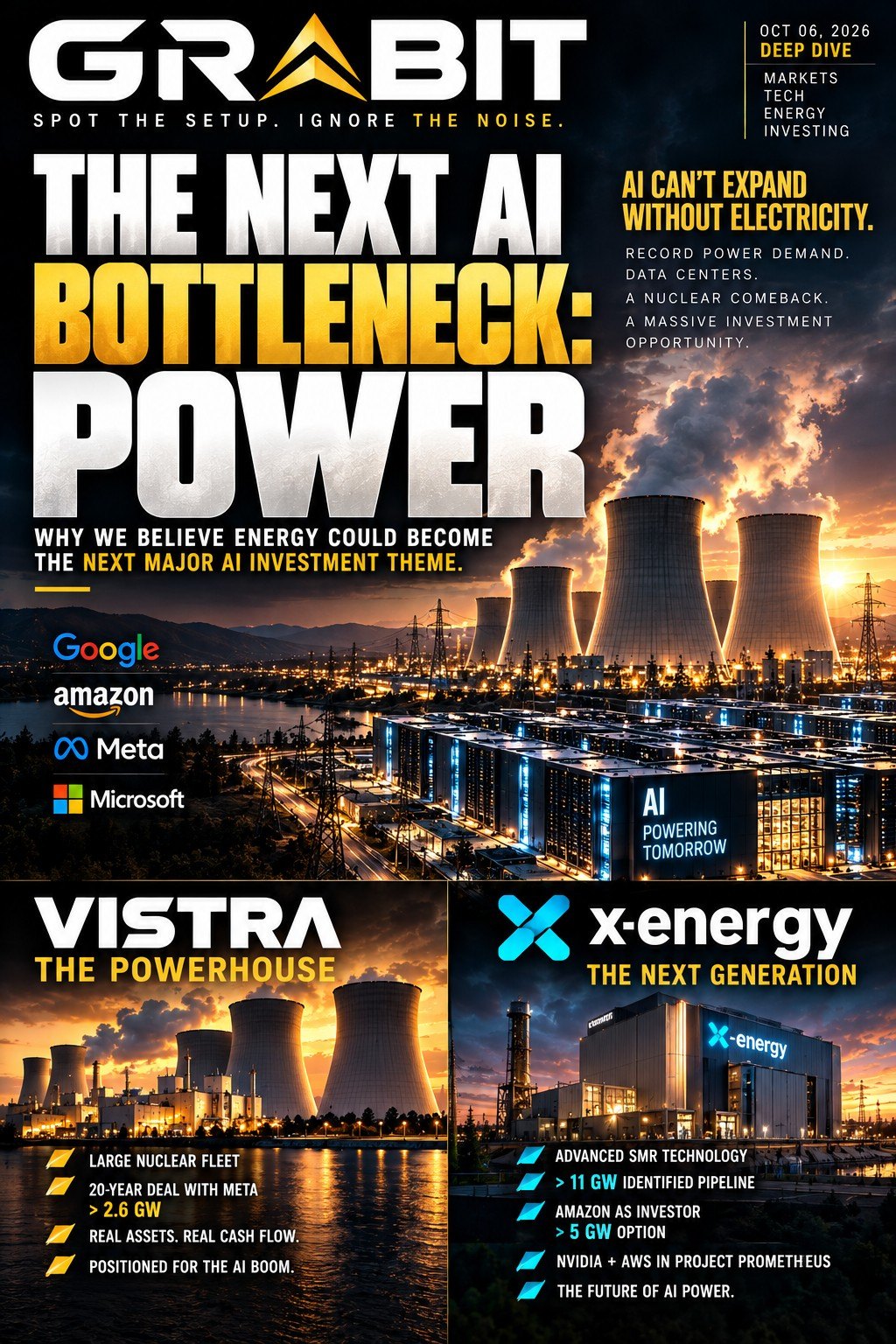
AI kan inte växa utan el. Rekordhög elförbrukning, datacenter och kärnkraftens comeback – därför tror vi att energi kan bli nästa stora AI-tema. Vistra är Power Today, X-energy är Power Tomorrow.
AI-racet har gått in i sin nästa fas.
Vi pratar ständigt om GPU:er, datacenter, Nvidia, hyperscalers och mer beräkningskraft.
Men ju mer jag tittar på vad som faktiskt händer i USA, desto mer övertygad blir jag av en sak.
AI kan inte fortsätta växa i den här takten utan mer el.
Och därför tror vi på Grabit att el kan bli nästa stora flaskhals för AI.
Det här handlar inte längre om en teoretisk möjlighet.
USA förväntar sig rekordhög elförbrukning 2026 och 2027, och datacenter pekas ut som en viktig drivkraft.
Och det är då det börjar bli riktigt intressant.
Kärnkraftens comeback
Kärnkraft har en egenskap som plötsligt är väldigt värdefull igen.
Den kan leverera stabil elektricitet dygnet runt.
AI-datacenter kan inte stängas av bara för att solen gått i moln eller vinden slutat blåsa.
Det betyder inte att sol och vind är oviktiga. Tvärtom kommer energimixen sannolikt bestå av flera olika energikällor.
Men när världen bygger datacenter som ska köra AI-modeller 24 timmar om dygnet blir tillgången på stabil och pålitlig elektricitet extremt viktig.
Och marknaden börjar se samma sak.
Googles nya samarbete med Constellation Energy innebär ytterligare 890 megawatt kärnkraft till nätet, samtidigt som det totala avtalet uppgår till 3,59 gigawatt.
Constellation planerar dessutom att investera över 4,3 miljarder dollar för att öka kapaciteten vid befintliga kärnkraftverk.
Och det här är inte längre en teoretisk framtid.
Amazon har också tecknat ett 20-årigt kraftavtal som stödjer utbyggnaden av kärnkraftverket Calvert Cliffs i Maryland.
Det här är verkliga signaler från några av världens största techbolag.
De behöver mer power.
Power Today — Vistra
Därför gillar jag Vistra i det här caset.
- De har redan kapacitet.
- De har redan befintliga kraftverk.
- De har redan kärnkraft.
- Och de har redan stora kunder som vill säkra långsiktig tillgång till elektricitet.
Ett tydligt exempel är avtalet med Meta på över 2,6 gigawatt från tre kärnkraftverk.
Vistra har dessutom möjlighet att öka produktionen från befintliga anläggningar genom så kallade uprates.
Det är precis den typen av tillgångar som plötsligt blir strategiska när efterfrågan på elektricitet exploderar.
För oss representerar Vistra:
POWER TODAY.
De behöver inte vänta på att en helt ny energiteknik ska bli kommersiell.
De sitter redan på infrastrukturen.
Power Tomorrow — X-energy
Men om Vistra representerar Power Today, så är X-energy enligt oss ett av de mest intressanta casen på andra sidan av ekvationen:
POWER TOMORROW.
X-energy försöker inte bara bygga ännu ett traditionellt kärnkraftverk.
Bolaget utvecklar en ny generation små modulära reaktorer, så kallade SMR, genom sin Xe-100-teknik.
Xe-100 är designad som en högtemperatur-gasreaktor och använder helium som kylmedel tillsammans med TRISO-X-bränsle.
En Xe-100-reaktor är designad för cirka 80 MW elektrisk effekt och kan kombineras i större anläggningar.
Det intressanta här är inte bara siffrorna.
Det är riktningen.
Det här är inte 80-talet
Jag tror att många fortfarande associerar kärnkraft med 1980-talet.
Gamla reaktorer. Gamla säkerhetssystem. Gamla bilder.
Men det här är inte 80-talet längre.
- Tekniken har utvecklats.
- Reaktordesigner har utvecklats.
- Bränsletekniken har utvecklats.
Och framför allt har behovet förändrats.
För 20 år sedan handlade mycket av energidebatten om utsläpp och energisäkerhet.
Nu har vi fått ytterligare en enorm efterfrågedrivare:
AI.
Vi bygger datacenter som kräver enorma mängder elektricitet.
Och den här efterfrågan kommer inte försvinna om AI fortsätter utvecklas.
Tvärtom.
Amazon + NVIDIA
Det som gör X-energy extra intressant för oss är vilka som står bakom utvecklingen.
Amazon har investerat i X-energy och bolagen arbetar mot en potentiell utbyggnad av flera gigawatt avancerad kärnkraft.
Amazon har dessutom kopplat X-energy till sin plan för Energy Northwest i Washington.
Men sedan händer något ännu mer intressant.
X-energy är en del av Project Prometheus, tillsammans med bland andra NVIDIA, Amazon Web Services och Idaho National Laboratory.
Projektet handlar om att använda AI för att accelerera utvecklingen av avancerad kärnkraft.
Läs det en gång till.
AI ska hjälpa till att bygga nästa generations kärnkraft.
Och nästa generations kärnkraft ska i sin tur ge energi till AI.
Det skapar en väldigt intressant feedback-loop.
Amazon och NVIDIA ser något
Här kommer en av de saker jag tycker är mest intressanta.
Amazon och NVIDIA är två av de bolag som sitter längst fram i AI-revolutionen.
- De bygger infrastrukturen.
- De säljer beräkningskraften.
- De bygger datacenter.
De vet bättre än de flesta hur mycket elektricitet som kommer att krävas.
Och ändå väljer de att lägga kapital, resurser och teknisk kompetens på nästa generations kärnkraft.
Vi tror inte att det är en slump.
Det betyder självklart inte att X-energy automatiskt blir en vinnare. Det finns fortfarande stora risker:
- Reglering
- Byggkostnader
- Tidsplaner
- Kommersialisering
- Konkurrens från andra energikällor
Men signalen är svår att ignorera.
De som bygger AI-framtiden börjar investera i infrastrukturen som ska ge AI-framtiden energi.
Det är exakt den typen av signaler vi letar efter på Grabit.
Men det finns ett ännu större problem
Det räcker inte att producera mer el.
Du måste kunna få elektriciteten dit där den behövs.
Och här kommer USA:s elnät in.
USA:s elnät byggdes inte för en värld där hundratals nya datacenter samtidigt kräver enorma mängder elektricitet.
Mycket av den amerikanska infrastrukturen är dessutom gammal och byggdes för helt andra belastningsmönster.
Nu förändras allt. AI. Datacenter. Elektrifiering. Ny amerikansk industri. Tillverkning som flyttar tillbaka till USA.
Allt detta kräver mer power. Och det kräver ett nät som klarar det.
Det betyder att USA måste investera enorma summor i:
- Transmission
- Distribution
- Transformatorer
- Substationer
- Switchgear
- Grid infrastructure
Det är nästa lager i vår tes.
Power är inte bara kärnkraft
Det är här jag tycker att marknaden kan missa något.
När man pratar om AI och energi tänker många direkt: Nuclear.
Men vår tes är större än så.
Vi tror på hela power-stacken.
Först måste elektriciteten produceras. Sedan måste den transporteras. Sedan måste den distribueras. Och slutligen måste den hanteras inne i datacentret.
Det öppnar upp en helt annan grupp av bolag.
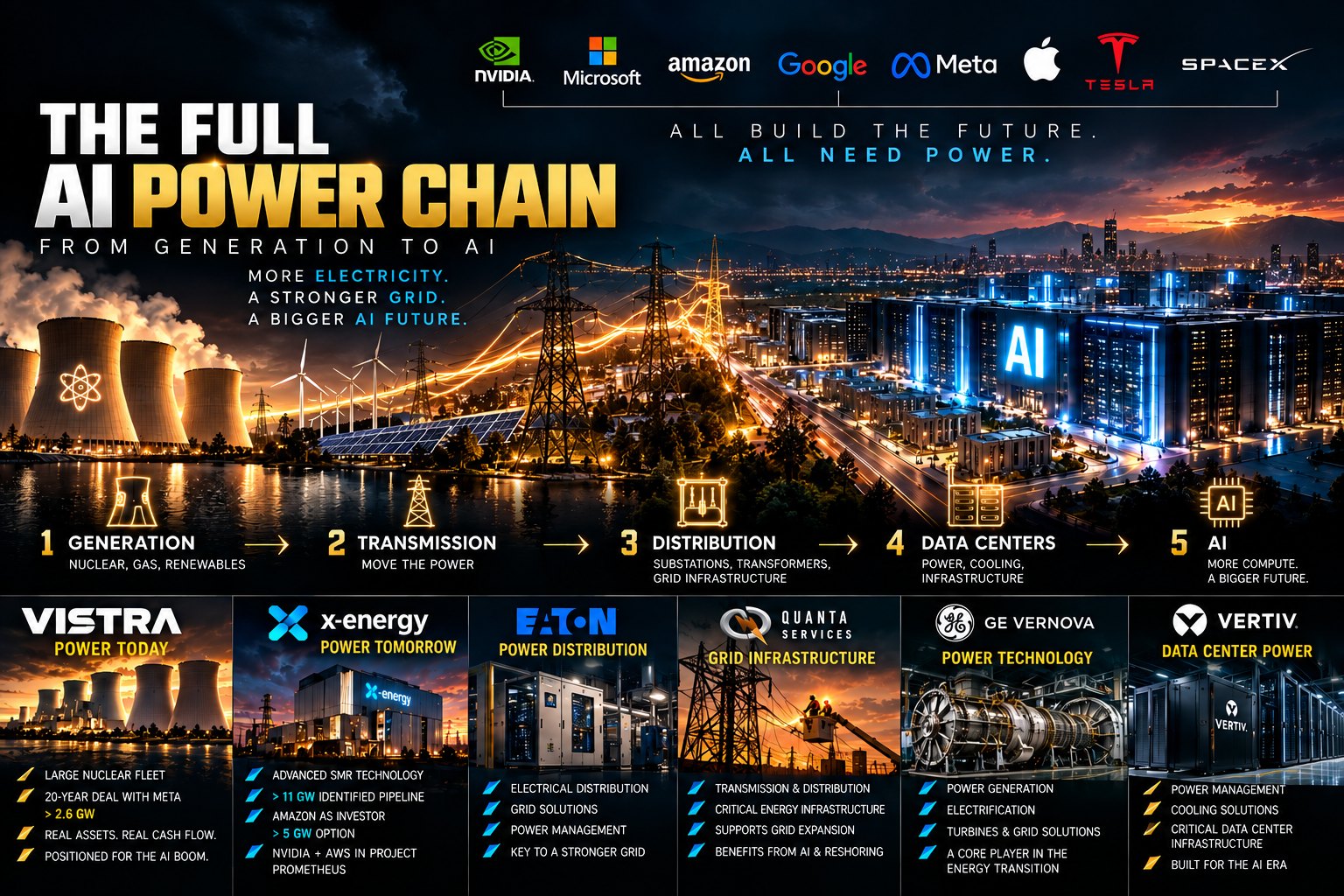
Det här är bolag som på olika sätt bygger infrastrukturen runt den ökande elektrifieringen.
- Eaton – en viktig spelare inom elektrisk distribution och power management.
- Quanta Services – bygger och underhåller kritisk energi- och transmissionsinfrastruktur.
- GE Vernova – arbetar både inom kraftproduktion och elektrifiering.
- Hubbell – levererar komponenter till elnätet.
- Vertiv – sitter närmare själva datacentret och arbetar med power management och kylning.
De är inte samma case.
Men de har en gemensam nämnare:
AI behöver deras produkter och infrastruktur för att kunna växa.
Och det är det som gör tesen så intressant
Vi behöver inte veta exakt vilket AI-bolag som vinner. Det är det fina.
Vi behöver inte veta om nästa stora AI-modell kommer från Nvidia, Google, Microsoft, Amazon eller någon helt ny aktör.
För oavsett vem som vinner kommer de behöva mer elektricitet.
Och det är där vi börjar tänka annorlunda på AI-investeringar.
Tidigare var frågan: Vem bygger den bästa GPU:n?
Sedan blev frågan: Vem bygger datacentren?
Nu börjar frågan bli: Varifrån kommer elektriciteten?
Och ännu viktigare:
Hur får vi elektriciteten till datacentren?
Det är där vi tror att nästa stora flaskhals kan finnas.
The Power Stack
Det är en enorm investeringskedja.
Och den har precis börjat accelerera.
Vår Grabit-take
Det här är varför vi på Grabit tror att Power kan vara nästa stora AI-bottleneck.
Vistra ger oss:
POWER TODAY.
X-energy ger oss:
POWER TOMORROW.
Och bolag som Eaton, Quanta Services, GE Vernova, Hubbell och Vertiv ger oss infrastrukturen runt omkring.
Vi tror inte att det handlar om att välja mellan kärnkraft, gas, sol eller vind.
Vi tror att USA kommer behöva allt. Efterfrågan växer helt enkelt för snabbt.
Det viktiga är vem som kan producera elektriciteten, vem som kan transportera den och vem som bygger infrastrukturen som krävs för att hantera den.
Och sedan kommer den stora frågan. Titta på vilka som bygger AI-infrastrukturen.
- Nvidia behöver power.
- Microsoft behöver power.
- Apple behöver power.
- Amazon behöver power.
- Alphabet behöver power.
- Meta behöver power.
- Tesla behöver power.
- SpaceX behöver power.
Alla bygger framtiden på mer elektricitet.
Och någon måste producera den. Någon måste transportera den. Någon måste distribuera den. Och någon måste bygga infrastrukturen som gör att allt faktiskt fungerar.
Det är där vi tror att nästa stora AI-investering kan finnas.
AI är inte längre bara en compute-story. AI är en power-story.
POWER ISN’T THE SIDE STORY ANYMORE. POWER IS THE STORY.
— GRABIT LABS
Nivåer & betyg för VST & XE
Det här är Grabits Bottleneck Take. Analysen ovan är gratis – våra nivåer, betyg och slutsats finns för PRO-medlemmar:
- Grabit-betyg och slutsats
- Nivåer för entry, stopp och mål
- Hela vår tes – och larm när läget ändras
Inte medlem? 7 dagar gratis, avsluta när du vill.
The Next AI Bottleneck: Power
AI can't expand without electricity. Record power demand, data centers and a nuclear comeback – why we believe energy could become the next major AI investment theme. Vistra is Power Today, X-energy is Power Tomorrow.
The AI race has entered its next phase.
We constantly talk about GPUs, data centers, Nvidia, hyperscalers and more computing power.
But the more I look at what is actually happening across the US, the more convinced I become of one thing.
AI cannot keep growing at this pace without more electricity.
And that is why, at Grabit, we believe power could become the next major bottleneck for AI.
This is no longer a theoretical possibility.
The US is heading toward record electricity consumption in 2026 and 2027, with data centers emerging as an important driver.
And that is where things get really interesting.
The nuclear comeback
Nuclear power has one characteristic that has suddenly become extremely valuable again.
It can deliver stable electricity around the clock.
AI data centers cannot simply shut down because the sun is behind a cloud or the wind stops blowing.
That does not mean solar and wind are unimportant. Quite the opposite. The future energy mix will likely include multiple sources.
But as the world builds data centers that need to run AI workloads 24 hours a day, access to stable and reliable electricity becomes extremely valuable.
And the market is starting to see the same thing.
Google's new partnership with Constellation Energy adds another 890 megawatts of nuclear power, while the broader arrangement totals 3.59 gigawatts.
Constellation also plans to invest more than $4.3 billion to increase output at existing nuclear plants.
And this is no longer a theoretical future.
Amazon has also signed a 20-year power agreement supporting the expansion of the Calvert Cliffs nuclear plant in Maryland.
These are real signals from some of the world's largest technology companies.
They need more power.
Power Today — Vistra
That is why I like Vistra in this case.
- They already have capacity.
- They already have existing power assets.
- They already have nuclear.
- And they already have major customers looking to secure long-term access to electricity.
A clear example is its agreement with Meta for more than 2.6 gigawatts across three nuclear plants.
Vistra can also increase output from existing facilities through so-called uprates.
That is exactly the kind of infrastructure that suddenly becomes strategic when electricity demand starts accelerating.
For us, Vistra represents:
POWER TODAY.
They do not have to wait for an entirely new energy technology to become commercial.
They already own the infrastructure.
Power Tomorrow — X-energy
But if Vistra represents Power Today, then X-energy is, in our view, one of the most interesting cases on the other side of the equation:
POWER TOMORROW.
X-energy is not simply trying to build another traditional nuclear power plant.
The company is developing a new generation of small modular reactors, or SMRs, through its Xe-100 technology.
Xe-100 is designed as a high-temperature gas reactor using helium as a coolant and TRISO-X fuel.
A Xe-100 reactor is designed for approximately 80 MW of electrical output and can be combined into larger facilities.
What matters here is not just the numbers.
It is the direction.
This is not the 1980s
I think many people still associate nuclear power with the 1980s.
Old reactors. Old safety systems. Old images.
But this is not the 1980s anymore.
- The technology has evolved.
- Reactor designs have evolved.
- Fuel technology has evolved.
And above all, the need has changed.
Twenty years ago, much of the energy debate was about emissions and energy security.
Now we have another enormous demand driver:
AI.
We are building data centers that require enormous amounts of electricity.
And if AI continues to develop, that demand is not going away.
Quite the opposite.
Amazon + NVIDIA
What makes X-energy particularly interesting to us is who is involved.
Amazon has invested in X-energy, and the companies are working toward a potential deployment of several gigawatts of advanced nuclear power.
Amazon has also connected X-energy to its Energy Northwest plans in Washington.
But then something even more interesting happens.
X-energy is part of Project Prometheus, together with companies and institutions including NVIDIA, Amazon Web Services and Idaho National Laboratory.
The project is focused on using AI to accelerate the development of advanced nuclear power.
Read that again.
AI is being used to help build the next generation of nuclear power.
And next-generation nuclear power could, in turn, provide energy for AI.
That creates a very interesting feedback loop.
Amazon and NVIDIA see something
This is one of the things I find most interesting.
Amazon and NVIDIA are two of the companies sitting at the front of the AI revolution.
- They build the infrastructure.
- They sell the compute.
- They build data centers.
They understand better than most how much electricity will be required.
And yet they are choosing to put capital, resources and technical expertise behind next-generation nuclear power.
We do not think that is a coincidence.
That does not mean X-energy automatically becomes a winner. There are still major risks:
- Regulation
- Construction costs
- Timelines
- Commercialization
- Competition from other energy sources
But the signal is difficult to ignore.
The companies building the AI future are starting to invest in the infrastructure that will power that AI future.
That is exactly the kind of signal we look for at Grabit.
But there is an even bigger problem
It is not enough to produce more electricity.
You need to be able to get that electricity to where it is needed.
And this is where the US power grid comes in.
The US grid was not built for a world where hundreds of new data centers could simultaneously demand enormous amounts of electricity.
Much of the American infrastructure is also aging and was built for very different load patterns.
Now everything is changing. AI. Data centers. Electrification. New American industry. Manufacturing moving back to the US.
All of this requires more power. And it requires a grid that can handle it.
That means the US needs to invest enormous amounts in:
- Transmission
- Distribution
- Transformers
- Substations
- Switchgear
- Grid infrastructure
That is the next layer of our thesis.
Power is not just about nuclear
This is where I think the market may be missing something.
When people talk about AI and energy, many immediately think: Nuclear.
But our thesis is bigger than that.
We believe in the entire power stack.
First, electricity has to be generated. Then it has to be transmitted. Then it has to be distributed. And finally, it has to be managed inside the data center.
That opens up a completely different group of companies.
These companies are building different parts of the infrastructure around rising electrification.
- Eaton – a major player in electrical distribution and power management.
- Quanta Services – builds and maintains critical energy and transmission infrastructure.
- GE Vernova – operates across power generation and electrification.
- Hubbell – supplies components used throughout the electrical grid.
- Vertiv – sits closer to the data center itself, working on power management and cooling.
They are not the same investment case.
But they share one common denominator:
AI needs their products and infrastructure to scale.
And that is what makes the thesis so interesting
We do not need to know exactly which AI company wins. That is the beauty of it.
We do not need to know whether the next major AI model comes from Nvidia, Google, Microsoft, Amazon or an entirely new player.
Because whoever wins will need more electricity.
And that is where we start thinking differently about AI investing.
The question used to be: Who builds the best GPU?
Then it became: Who builds the data centers?
Now the question is becoming: Where does the electricity come from?
And even more importantly:
How do we get that electricity to the data centers?
That is where we believe the next major bottleneck could be.
The Power Stack
It is an enormous investment chain.
And it has only just started accelerating.
Our Grabit take
This is why, at Grabit, we believe Power could be the next major AI bottleneck.
Vistra gives us:
POWER TODAY.
X-energy gives us:
POWER TOMORROW.
And companies such as Eaton, Quanta Services, GE Vernova, Hubbell and Vertiv give us the infrastructure around it.
We do not think this is about choosing between nuclear, gas, solar or wind.
We think the US will need all of them. Demand is simply growing too quickly.
The important question is who can generate the electricity, who can transmit it and who is building the infrastructure required to handle it.
And then comes the bigger question. Look at the companies building the AI infrastructure.
- Nvidia needs power.
- Microsoft needs power.
- Apple needs power.
- Amazon needs power.
- Alphabet needs power.
- Meta needs power.
- Tesla needs power.
- SpaceX needs power.
They are all building the future on more electricity.
And someone has to produce it. Someone has to transmit it. Someone has to distribute it. And someone has to build the infrastructure that makes all of it work.
That is where we believe the next major AI investment opportunity could be.
AI is no longer just a compute story. AI is a power story.
POWER ISN’T THE SIDE STORY ANYMORE. POWER IS THE STORY.
— GRABIT LABS
Levels & score for VST & XE
This is Grabit's Bottleneck Take. The analysis above is free – our levels, score and verdict are for PRO members:
- Grabit score and verdict
- Entry, stop and target levels
- Our full thesis — and alerts when the setup changes
Not a member? 7 days free, cancel anytime.